Today I was the weakest link. That was not funny. Nor was it pretty. A valuable learning point though. In survival cultures (in tribal Africa, for instance, or in the heart of Hillbrow, Johannesburg) you need to outrun the weakest in your group, and then you are fine. The weakest is not. The predators are happy. In secular-rational cultures (using the Inglehart terminology) the group loses together with the weak one.
The old maxim still holds water: the whole is only as reliable as the weakest member or link. If I am not the sharpest tool in the shed when it comes to Financial Accounting and I need to represent the team on the subject, guess what happens. Yeah, I screwed it up. I felt bad. Not because I could not legibly explain the ratios, but because my team was looking at me disapprovingly. I studied the ratios the night before but I am no mathematician and thinking numbers on my feet is not my forte, and I am cool with that - I know my areas of improvement. Still, if this happens in a graded activity, I will not be the most popular chap with my mates.
The learnings are obvious and I don't want to be moralistic here. Now I understand much better why leaders flying solo fall down so often, fast and hard: if they don't have their followers at the same level, they won't get very far. So looking in the rear view window is after all not such a bad idea.
Showing posts with label team effectiveness. Show all posts
Showing posts with label team effectiveness. Show all posts
Wednesday, May 19, 2010
Tuesday, May 18, 2010
Poultry, Tchaikovsky and Teamwork
This is one of my favorite ballet pieces. Since I was a child, this melody has mesmerized me. The little swans are so graceful, so weightless, like four snowflakes pirouetting in perfect unison over the surface of the lake.
When teams are united, when there is a shared understanding of the objectives and everybody is absolutely sure of what needs to happen, you can observe similar seamless execution of tasks. What is, let's imagine, one of the swans decides that she (or he, if it is a male swan) is smarter than the other swans and performs altogether different kicks and moves than the rest of the flock. Not only will she/he introduce dissonance into the overall piece, but also will endanger her/his flockmates (who can get knocked over/drowned/shot... choose your favorite corporate analogy).
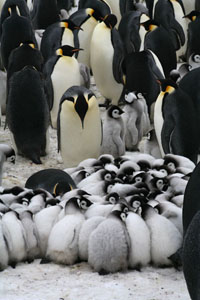
Finally, coming back to swans, one learning I personally took away from watching those magnificent creatures:
you can kick and paddle like held beneath the surface, fighting whatever battles might come your way, but to your team you must always come across as if your are in full control of the situation.Panic begets chaos and destruction while confidence helps those around you get mobilized and focused on the task. So next time you feel like you are losing it, go watch Swan Lake
 .
.


Subscribe to:
Posts (Atom)
LinkWithin
